

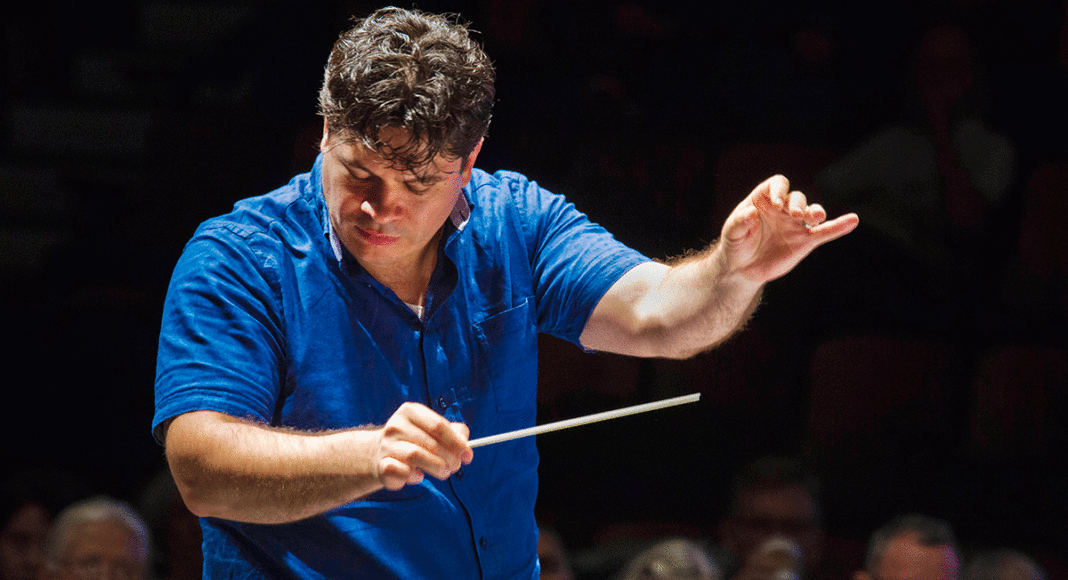
Living up to “bigger and better than ever” hype, here comes the 56th season of the homegrown festival with a worldwide reach. Under the leadership of Cristi Măcelaru, the Cabrillo Festival of Contemporary Music comes to town next week with an abundance of very fresh musical ideas that span the globe from Romania to China to Canada to Korea.
This year’s festival offers two world premieres, three U.S. premieres, and seven West Coast premieres. The musicians and performers involved have been recipients of Pulitzer Prizes, Grammys, and Oscars. Several works have been commissioned by and for the festival, guaranteeing that audiences will be treated to never-before-heard musical experiences.
So how does this premiere programming happen? We talked with the director, a composer, and a performer about what happens behind the scenes.
The Director: Cristi Măcelaru
Speaking from a conducting gig in Munich, maestro Cristi Măcelaru says this year’s world premieres tie into what has become a Cabrillo Festival trademark. “Premiere performances are important, because they reinforce and redefine who we are as a festival,” he says. A big aspect of contemporary music is “not only the performing. It is also the commissioning of new music. When you commission a new piece, you are flying blind. Well, almost,” he laughs. “You are making an informed guess—and definitely take a risk. It’s different than performing a known work.”
In offering premiere performances, the festival brings new life to the music world. There will always be Beethoven and Mozart, but now there can also be Muhly, Shahov, and Clyne. It’s an expansion of the global imagination. “To think of the Cabrillo Festival only as performing contemporary music isn’t enough,” Măcelaru reminds me. “It also has a role as a commissioning agent, to bring new work into the world.”
The opening concert features a U.S. premiere by Romanian composer Dan Dediu. “He is a composer I met after I left Romania to live in the United States,” the maestro explains. “When I went back to Bucharest asking about leading Romanian composers, everyone recommended Dediu. He’s a very accomplished composer. I listened to a lot of his work for orchestra. It’s incredibly creative and fun and beautiful— plus it’s virtuosic for the orchestra.”

Also on the program for the first concert is the festival commission world premiere of Piano Concerto No. 2, by Macedonian Pande Shahov. “Shahov’s piano concerto was written for, and will be performed by, fellow Macedonian Simon Trpceski. He is a great pianist,” Măcelaru says.”We’ve worked together several times before. When we have, he always wants to play, as an encore, something from his country.”
Trpceski’s encores always involved Macedonian folk dance music, which gave Măcelaru an idea. “I proposed that he might like to do a suite of dances as a concerto. Then he mentioned the composer he’d worked with, Pande Shakhov,” he says. “So it came about—filled with crazy rhythms, and complex harmonies, just what you’d expect from southern Balkan music. I can’t wait to hear it.”
The composer Shahov says that he “aimed at creating a texture which resembles a tapestry or a kaleidoscope.” And in the center of this the virtuosity of pianist Trpceski—who worked closely with the composer—will translate the musical and folkloric colors of his native country into a journey across Macedonian musical heritage.
Romanian-born Măcelaru has clearly enjoyed programming his second season at Cabrillo’s podium. “For me, this festival has been a discovery. The Bay Area community feels so right for contemporary music. And this year I come back knowing more what to expect. I think it’s the difference between the excitement of going somewhere new, and the excitement of coming home. This time I’m coming home.”
The Composer: Nico Muhly
Nico Muhly is the only one of the 18 featured composers who will not be in residence this season. But he has a good excuse for why he is unable to be here for the West Coast premiere of Impossible Things, a double concerto for tenor, violin and string orchestra. The composer will be in New York conducting the technical rehearsal for his new opera Marnie—which opens at the Metropolitan Opera in October. “I’ve had that on my calendar since September 2014,” he says.
A bona fide prodigy of the crossover musical landscape, Muhly does it all: operas, song cycles, choral works, concerti, and an electrifying dive into the poetry of C.P. Cavafy. Based in New York, former boy soprano Muhly has composed for films, Broadway, and Björk. For many years an editor and archivist with Philip Glass, Muhly pushes the term postmodern to its limits. Of Marnie—his third opera—he admits, “of course it is a big deal. It’s the biggest piece I’ve ever written.” On the other hand, he admits, “right now I’m writing something for a solo lute. Every piece has to feel like a big deal, or else why are you doing it?”
Impossible Things is one of his favorite pieces that he’s written, says Muhly. “It was commissioned for a duo concerto voice and violin for Pekka Kuusisto (violin) and Mark Padmore (tenor). They toured with it all over the U.K. and Europe, with many performances, and then it sort of disappeared.” Muhly is thrilled that it will receive fresh life in Santa Cruz next week.
Muhly chose the text, a suite of poems by Cavafy—widely considered the most important Greek poet of the 20th century. Muhly knew the Cavafy translator, Daniel Mendelsohn, at Columbia. “To me, his translation combined the literal and poetic in a compelling way,” Muhly says. “So I cobbled together a triptych of poems.”

The compelling nature of Cavafy’s work, Muhly believes, is in the subtext.
“There was a magical space created by the opening section of poetry,” Muhly says. “That was a point of entry for me. Cavafy’s work always contains the unsaid thing: ‘Why should I remain with lips shut tight?’”
Muhly very much likes commissions—and the restrictions they bring. “Commissions are great. They are a challenge. Like being invited to a duel. Commissions and freeform composing are like complementary muscles. They work to refresh each other,” he says. “The different composing modes are complementary, not either/or.”
He starts out planning a piece by hand, and then inputs it into a computer. “Then I print it out—without the rests indicated—and work on more details, input it again, and then print it out again,” Muhly says. And back and forth in this way. In the case of the Cavafy piece, the abstraction of the beginning text offset the reality of the funeral cortege, the hanging. I also knew I wanted the opposite of passion, an atmosphere that offsets the erotic.”
As he wrote deeper into the composition, he found that the narrative juxtaposition “suggested musical textures. Much like architecture, or even better, like the layering of choices when curating an exhibition.”
One of Muhly’s favorite things in the piece is the relationship between voice and fiddler. “I thought so hard about how the text insists on one or the other, the voice or the violin, and why that is important,” he says. And he’s very happy with the scary passacaglia of the last section. “It’s a traditional form, so it’s unexpected,” he says of the slow triple time.
Muhly says he gets musical inspiration from the past, “like Benjamin Britten. I find those things incredible. Really incredible,” he says.
The Tenor: Nicholas Phan
Nicholas Phan, a celebrated tenor whose recordings of opera and lieder have attracted many Grammy nominations, performs across the globe. Phan makes his Cabrillo Festival debut with Muhly’s Impossible Things.
“Nico and I have known each other—and known of each other—since we both started living in New York,” Phan says. “And at some point he said ‘hey, check out this score.’” Phan did, and pronounced it “stunning.” Phan, who debuted Muhly’s piece in New York several years ago, says that when he found out Măcelaru was newly involved with the Cabrillo Festival, he asked him to check out the Muhly piece. “I thought it would make the perfect collaboration.”
“This piece is a great fit for my voice,” says Phan. “That shocked me at first, that it felt so natural to sing. I feel a sort of kinship artistically with Nico.” And with maestro Măcelaru as well. “Christi and I met at the Philadelphia Orchestra. We did the Messiah, several times, and we’ve been to Romania together. I think the world of what Christi does. He’s a serious musician,” says Phan.
Phan says his approach to most vocal music is the same. “Vocal music illustrates a text through music. Music is an abstract way of engaging with human emotion. The words make it concrete,” explains the tenor, who began his musical career as a violinist. “First, you learn it all—the words, the music, the entire piece. And then you try to understand what the composer is trying to convey. And the more you perform a certain work the more layers reveal themselves.”

Phan describes Muhly’s piece “as a sort of double concerto—a dialogue between the tenor voice and the violin. The piece is actually reminiscent of Britten’s Serenade with the voice and the instrument. Vocal concertos are like chamber music, yet not as intimate as a song recital.”
The tenor finds the doubling of instruments especially provocative. Cabrillo Festival concertmaster and violinist Justin Bruns is a key element of this performance. “In this case, I view the violin as another voice, but with its own colors. Justin is someone I know very well, since we were students at Rice,” says Phan, who says it is always exciting to interact with the other instrument. “It’s my job to convey the meaning—and poetry’s tricky,” says Phan.
As a singer, Phan believes in trusting the material. “You have the ability to share this insight, to share the moment that we can all relate to,” he says.
Muhly’s work is notoriously intricate. “You have to keep your concentration,” says Phan. “Often just keeping the focus is a great challenge with new music. Partly because it’s not familiar.”
The sheer newness of this music is also its strength. “You have to hear it with fresh ears,” insists the tenor. “And what’s great is that it inspires us to hear all music with fresh ears.”
_____________________________
The Cabrillo Festival runs July 29 through Aug. 12, at the Santa Cruz Civic Auditorium. Nico Muhly’s ‘Impossible Things’ will receive its West Coast premiere featuring tenor Nicholas Phan and Cabrillo Festival concertmaster/violinist Justin Bruns on Sunday, Aug. 12.Go to cabrillomusic.org for tickets and info.